
Learning from Others
The TEC Court of Review shows us how ecclesial disciplinary opinions should be done!

The Court of Review for The Episcopal Church (TEC) recently issued a decision in a disciplinary matter that is worth reading by all interested in canon law and the judicial process. The hearing panel that tried the case found that the priest had committed financial misconduct and recommended that he be immediately deposed from ordained ministry in TEC. On appeal, the Court of Review remanded the case for a new hearing due to serious procedural errors by the hearing panel. I mention this decision to you for three reasons:
all three opinions in the matter are extremely well written and reasoned (and are worthy of emulation by their ACNA cousins at both the trial and appellate level);
the majority opinion, concurring opinion, and dissenting opinion in the matter interact with one another in a constructive manner that reflects both serious engagement with contrary ideas and respectful professionalism toward all involved (and are worthy of emulation by their ACNA cousins at both the trial and appellate level);
each opinion of the court contained observations that reflect serious consideration of the nature of ecclesial discipline that should be read, marked, and inwardly digested by all participants in the ecclesial disciplinary process. I will reproduce some of them here for those who are still reading.
The Opinion of the Court, joined by 13 members of the Court of Review, made several observations worth considering, especially in light of the recent ACNA experience in the Ruch matter. The Court wrote:
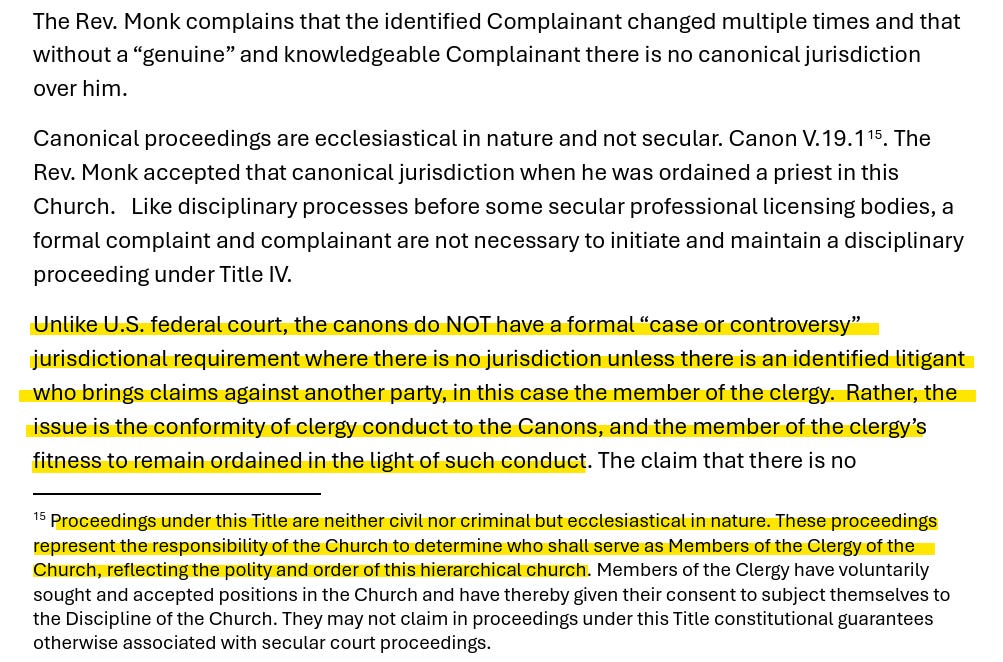
This is a key point: ecclesial trials are not purely adversarial proceedings! The issue before the court is rather simple: “the conformity of clergy conduct to the Canons, and the member of the clergy’s fitness to remain ordained in light of such conduct.” The members of the ACNA Court for the Trial of a Bishop and participating attorneys would be well advised to keep this straightforward task in mind when tempted to act as provincial ombudsmen, as the Ruch court did to its own detriment.
The Opinion of the Court also noted the following problem and governing principle:
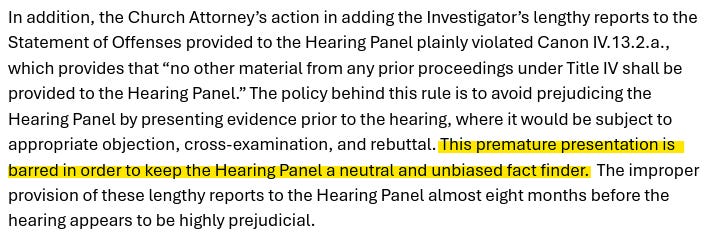
The TEC canon cited prohibits matters from the preliminary investigation of the matter from being provided to the Hearing Panel to preserve the trial court as “a neutral and unbiased fact finder.” This is very relevant to ACNA canon law because the latest (and possibly final) version of the canonical reforms rejects this approach and provides the trial court with all preliminary investigative matter. This profoundly misunderstands the meaning of an inquisitorial process as noted above and risks substantial prejudice to the impartiality of the adjudication.
The Concurring Opinion, authored by a single member of the Court, also raised a key principle in this observation:
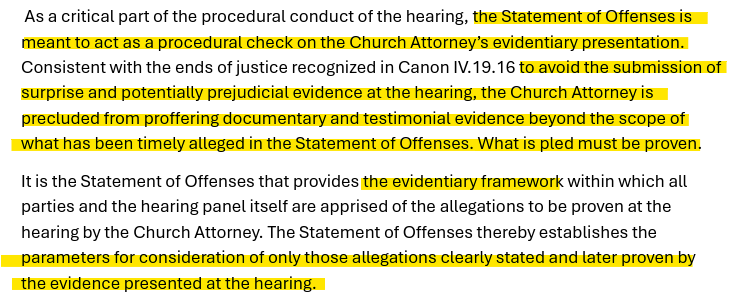
This explanation of the purpose of the “Statement of Offenses” is critical for properly understanding the intense focus of an ecclesial disciplinary proceeding. This is relevant to my ACNA readers because the “Statement of Offenses” — called a “presentment” in our canonical parlance, is not the equivalent of a “pleading” in an adversarial proceeding, sworn to by persons with knowledge, but rather guiding the proceedings and proof. This was the subject of much confusion by the Ruch court, and should not be repeated in the upcoming proceedings; in sum, it is largely irrelevant who signed a presentment — what matters is whether the factual allegations therein have been proven by clear and convincing evidence. As such, the charges should be reproduced verbatim (with appropriate redaction) in any decision/judgment/order of the trial court and not treated in the cursory fashion effected by the Ruch court.
The Dissenting Opinion, joined by four members of the Court of Review, is extremely well done and reflects a rare degree of legal accumen and draftsmanship. Its technical excellence aside, it offers the following reminder about Title IV ecclesial disciplinary proceedings, past and upcoming:
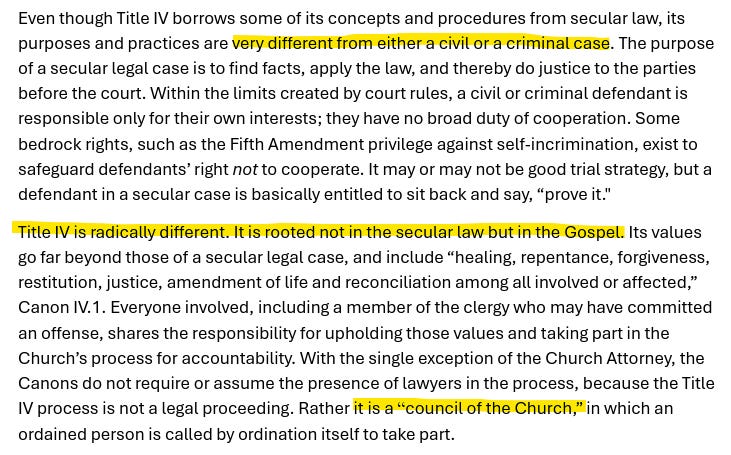
This notion of the disciplinary process as a “council of the Church” is extremely hard to implement when the process is as adversarial as the current ACNA disciplinary canons. The proposed revision to the ACNA canons that will come before the Provincial Council in June (and hopefully the Provincial Assembly for ratification thereafter) transform our current process away from a conflict-driven process with emphasis on attorneys and esoteric procedure to a laser focus on a simple compound question: whether the clergy charged complied with the canons alleged and whether, in light of that violation, he should remain in ordained ministry. Let us hope and pray that we can learn from our separated brethren and sisters in TEC and not repeat the mistakes that we made in our current system of canons and their application in the Ruch matter.
Many of those in ACNA leadership have a fondness for seeing others as adversaries when criticism arises. The defensiveness prevents sober reflection, amendment, and reconciliation.
I appreciate the comparison of the church disciplinary to that of a professional licensing board. If one has not acted in accordance with the standards required by the profession, consequences are most appropriate.
I want to praise the coherence of the majority and the dissent on all the important points this piece outlines about the nature of ecclesial discipline. It means they are speaking the same foundational language and are reasonably disagreeing on a fine (though important) legal point.
And I want to get out my megaphone and shout another point that the majority and the dissent agree on here -- first in the words of the dissent:
> Not only are Hearing Panels not made up of lawyers, there is as far as we can see no training available for Hearing Panels. Title IV training as conducted by dioceses and provinces mostly seems to focus on the early stages of the process, including intake and referral. Hearing Panels have detailed and complex procedural responsibilities, and it is unrealistic to expect them to succeed without focused and timely training. We urge The Episcopal Church to remedy this lack as a matter of urgency.
And in the words of the majority:
> Though our dissenting colleagues reach a different result, they agree that the hearing panel made serious errors in conducting the hearing. We specifically agree with footnote four of the dissent, which calls for training of hearing panels, and we join them in urging The Episcopal Church to take prompt steps to meet that need.